
AI Is the New Storefront
For 30 years, your website was your storefront.
A customer had a problem. They searched Google. They landed on your site. They browsed, compared, and bought. The entire journey happened on your turf, inside an experience you designed and controlled.
That's ending.
The shift no one named
Today, 800 million people open ChatGPT every month. Millions more use Claude, Gemini, Copilot. When they need something, they don't search. They ask.
"Find me a project management tool for a 10-person team."
"What's the best CRM for a Series A startup?"
"Plan me a trip to Tokyo for under $3,000."
The answer comes back inside the chat. No blue links. No landing page. No SEO ranking to fight over. Just a recommendation, maybe a comparison, and a next step.
If your business isn't in that answer, you don't exist.
This is the same shift that happened in 1995 when storefronts moved from Main Street to the internet. Companies that built websites early owned the next decade. Companies that waited became footnotes.
Websites were the first storefront migration
Think about what a website actually did for a business. It wasn't just a brochure online. It was a new surface where customers could find you, evaluate you, and buy from you. The companies that understood this early didn't just put their catalog on a webpage. They rethought how customers interact with their product.
Amazon didn't digitize a bookstore. They rebuilt the buying experience around search, reviews, and one-click checkout. That's what it means to be native to a new surface.
AI chat is the next surface. And the companies treating it like a marketing channel are making the same mistake as the ones who treated websites like digital flyers in 1998.
What "showing up in AI" actually means
Right now, most businesses show up in AI the way a model decides to represent them. You have zero control over the description, the positioning, the comparison. The AI pulls from your website, your reviews, maybe a blog post from 2022. It decides what matters. It frames you against competitors however it wants.
That's not a storefront. That's a game of telephone.
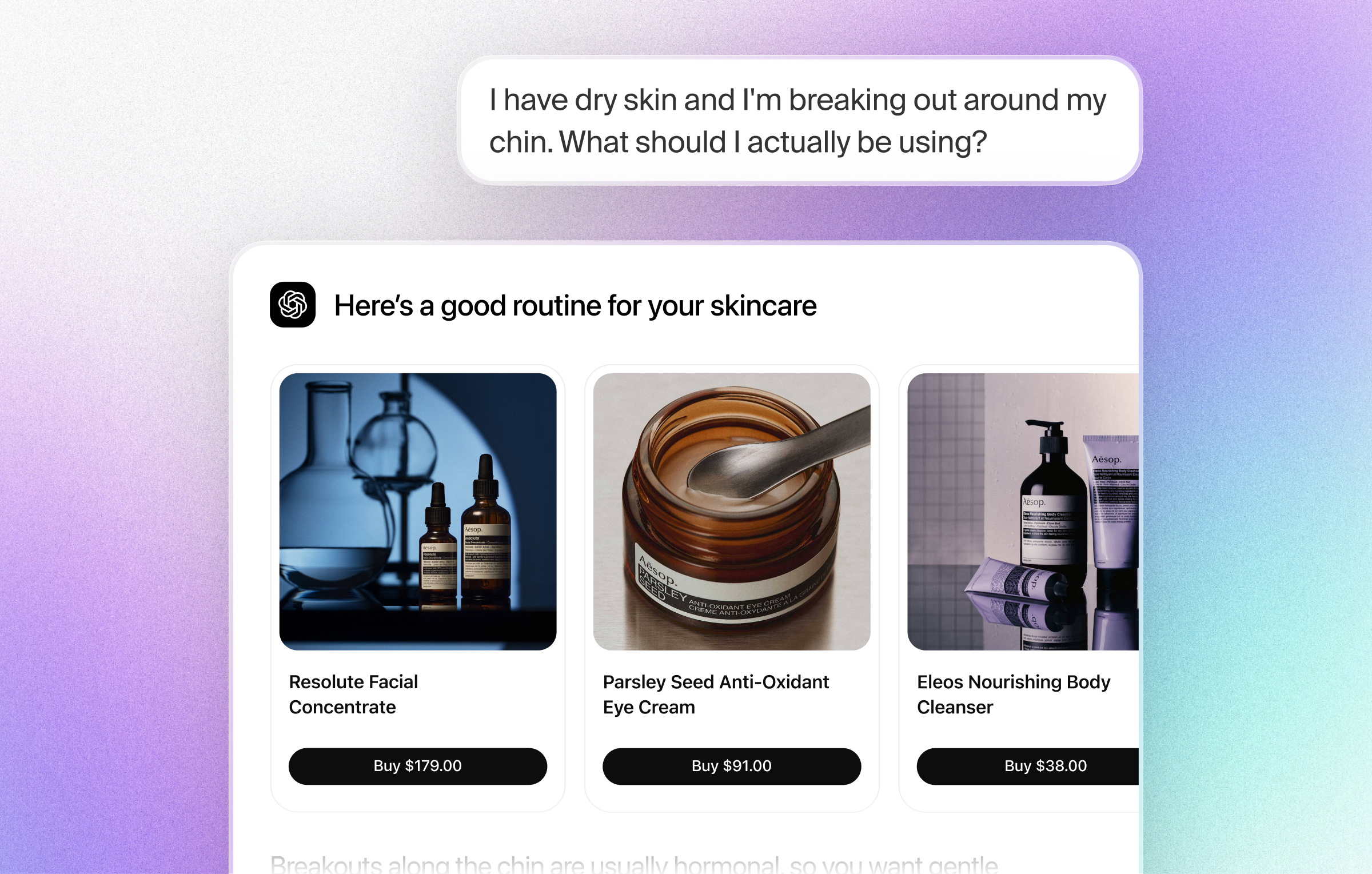
But AI platforms are changing fast. ChatGPT launched an App Directory in December 2025. Claude launched interactive apps in January 2026. For the first time, businesses can build real interfaces inside AI chat. Not chatbots. Interactive tools that respond to natural language, display visual components, and take actions.
A travel company can show you a map with available hotels, prices updating in real time. A SaaS product can walk you through an onboarding flow without you ever leaving the conversation. A retailer can let you browse, customize, and checkout inside the chat window.
This is what a storefront looks like in AI. Not a listing. Not a mention. A living, interactive experience where customers can discover you, evaluate you, and convert.
The window is open, but closing
Every platform shift has an early window where the economics are absurdly favorable. Google Ads in 2003. The App Store in 2009. SEO before everyone hired content farms.
AI apps are in that window right now. The directories are small. The competition is thin. The users are already there in massive numbers, asking for exactly what businesses sell.
The companies building inside AI today will have the distribution advantages, the user habits, and the iteration data that late movers can't replicate. Not because the technology gets harder. Because the attention moves on.
This isn't about chatbots
The "AI is the new storefront" framing only works if you take it seriously. A storefront isn't a sign on the door. It's the full experience of walking in, looking around, picking something up, asking a question, and deciding to buy.
Most businesses are still at the "sign on the door" phase with AI. They have a website that AI can scrape. Maybe they optimized for LLM mentions. That's table stakes, and it's not enough.
The real opportunity is building the experience. Owning how your brand shows up when someone asks. Giving customers something to interact with, not just read about.
In 1995, the question was: do you have a website? In 2026, the question is: do you have an AI storefront?
The companies that answer yes will own the next decade of distribution. The rest will wonder where their customers went.